CellCraft's
Idea
The
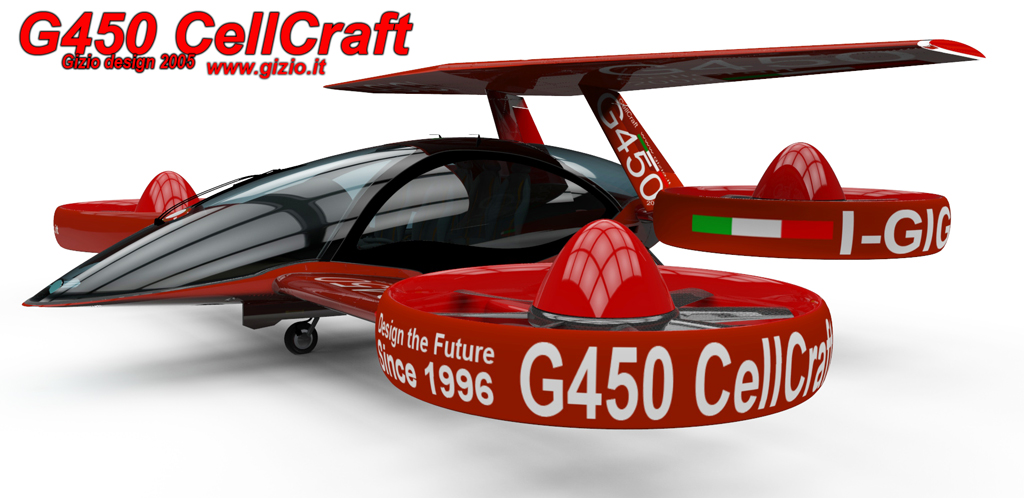
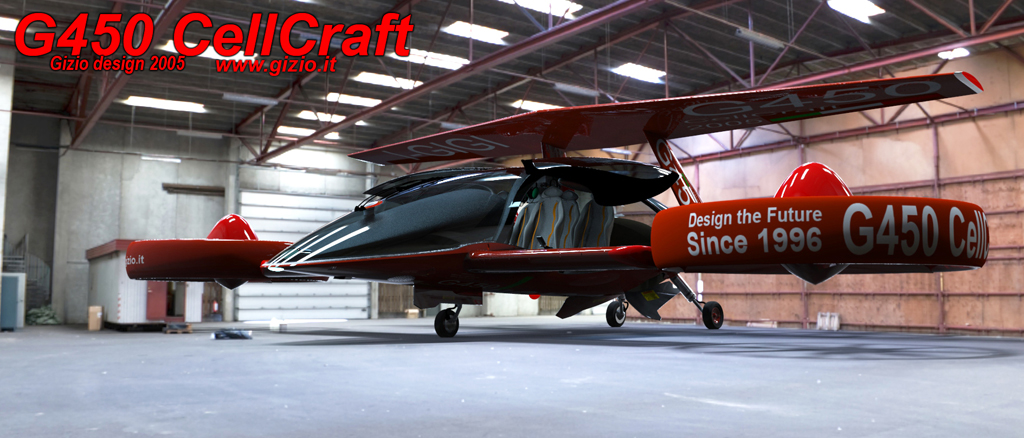
CellCraft G450 and G455, as
well as the previous sisters were basically made up of three basic
elements: the main body that also houses the motors-generators;
respectively one in the front area and the other in the rear.
Two lifting surfaces, which are generally constituted
by two front wings supporting both front rotors,
and a second situated in a central position,
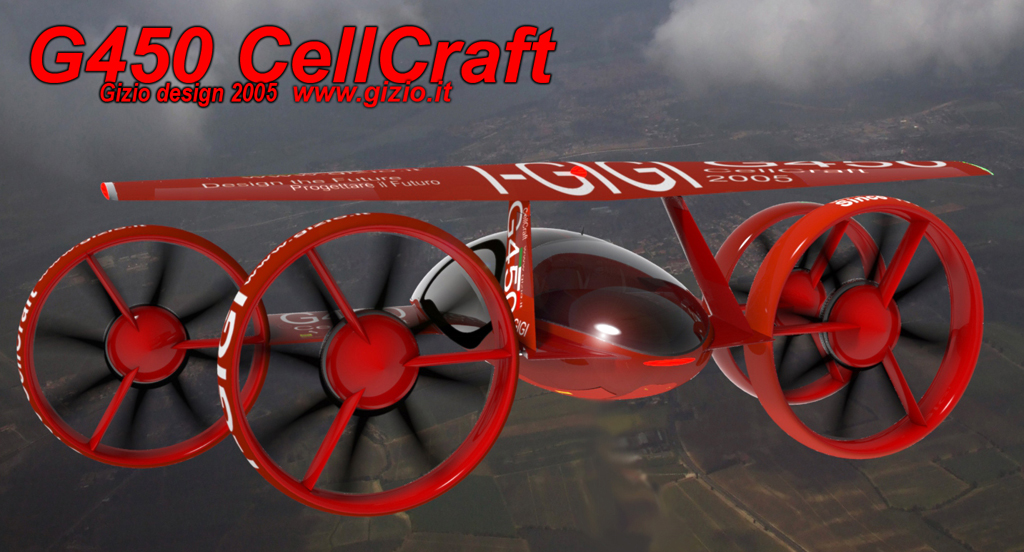
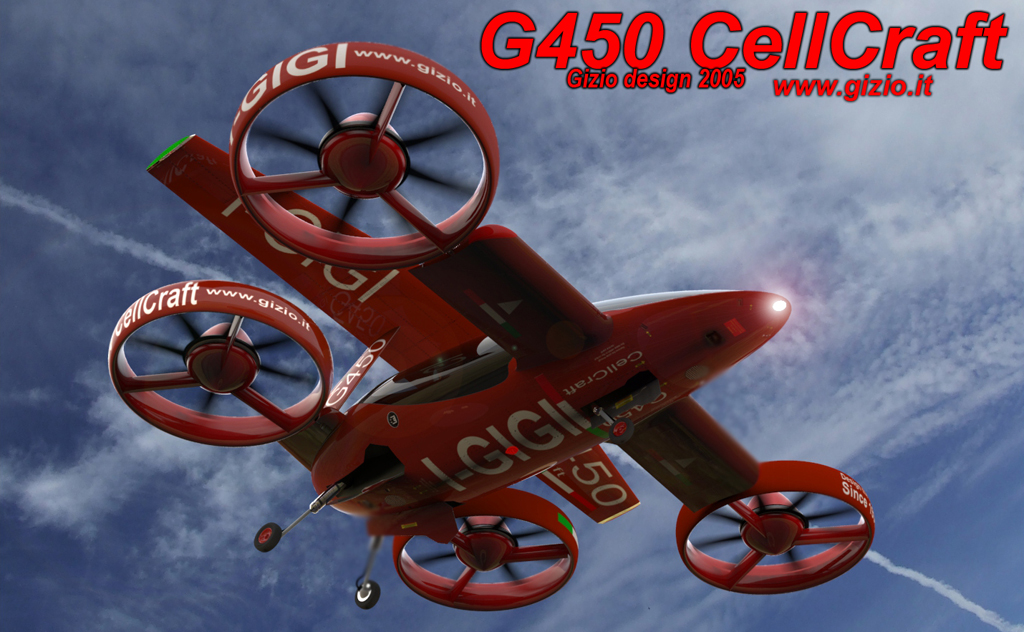
slightly frontward. Finally, four ducted-rotors
having a radical different architecture between the two main projects
described in this site.
Both rotors - which either the G450 and G455 are equipped with
- were designed having a ring structure capable
of producing a tilting movement with a total
angle of 120 °. This is after all the basic architecture of
both machines. Rotors can perform a rotation of 90 degrees forward,
and an opposite rearward within 30° respect to the horizontal
plane.
Each of ducted-rotor is provided with two electric motors
connected to a single articulated rotor like in the in G450. G455
instead has a smaller rotor diameter since it is made of two counter
rotating rotors. On both projects blades are suspended on an flexible
bearing which ensures a limited movement of both flapping and
pan tilting. It also guarantee a rotary movement on the longitudinal
axis of the blades, which provide an articulated rotation allowing
variations of the angle of attack exactly like happen on a common
helicopter. The maximum excursion angle of attack wouldn’t
be greater than 5° on the horizontal plane of rotation, which
allow a particularly excellent maneuverability in hovering flight.
These
type of aircraft are designed to be multi-role capable of a wide
versatility and numerous applications. CellCrafts
can carry up to five passenger; with an average speed of 480
Km/h (260 Miles), more than twice faster than a conventional
helicopter. It can land vertically over almost any kind of surface,
making this aircraft having a very high potential applications
in the aerospace market. Among the possible role in addition to
private transportation, the employment in emergency medical
rescue or logistical missions like in police
operation for example could be a very actractive opportunity
as well in some military activities; though I prefer conceiving
my aircrafts primarily for civilian application rather than for
military-strategic applications.
|
|
|
|
|
|
|
|
|
|
|
|
|
|
|
Both aircrafts, the G450
and the G455 as well as all previous projects,
were designed with different materials that would guarantee flexibility,
strength and endurance. Every
single detail of the aircraft use a variety of components depending
on the application and the role for wich the aricraft has been
designed, responding to defined functions according to mechanical
stress which any given element is adapted to bear.
The main body of the machine is supported by a steel and
aluminum frame settled at the base of the aircraft intended
to support the two turbo-generators or MPU
(Main Power Unit) respectively one in the bow, the other
in the queue of the aircraft. The CellCraft is
absolutely transmission-less type, it has no shaft of any kind
or other similar mechanisms which are absent in this latest version
exactly as it was on the G150, therefore no vibrations;
sacrified weight or precious space.
The fuel tanks are housed in the central area of the fuselage,
they are mainly two, one for each side and are connected via a
hydraulic system which provides for the automatic transfer of
fuel, ensuring a correct distribution of the weight and balance.
At the center of the fuselage below the floor, between the front
and the rear seats there is the stabilization system, consisting
of an identical pair of gyroscopes connected with the AFC
(Automatic Flight Control). Finally eight accelerometers
in a pair of two are housed in the bottom of each wing basement.
Along the horizontal axis of the aircraft there is placed, power
cables coming from the rear turbo-generator, and the optics cable
connecting the digital gyroscopes controller and finally the accelerometers,
eveything connected to and from the AFC. All
that pretty well distributed within the aircraft body.
All those equipments are connected to both, the numerical control
system and power distribution, respectively the RRC
and the AFC.
The
RRC (Rotor Revolution Control) is connected with
the main computer systems located in the inner shell of the instrument
panel of the aircraft: the AFC (Automatic Flight Control).
The RRC sends constantly electric impulses to
the eight electric motors, since it is the main computer control
of the electric propulsion system.
The information streaming coming from all the sensors arranged
in different points of the fuselage, including the rotors, flows
in a form of a digital stream through optical cables.
Optical cables are pretty light and able to carry a large quantity
of information, processed by the digital control system along
various program’s steps, while computing several operation
per second.
|
|
|
|
|
|
|
|
|
|
|
|
|
|
|
Flight
Management System (AFC)
The
aircraft is designed taking into account a number of variables
that identify the use and architecture for each one of the models.
Both aircraft, the G450 and G455
are propelled with a total of eight three-phase induction
electric motors, electronically controlled through a
system that manages both the power and the pitch angle of each
rotor’s blade, in accordance with the position of the machine
in the space, computing the right amount of power required to
guarantee the flight.
The control system of the rotors R.R.C. (Rotor Revolution
Control) ensures a rapid response to any request of variation
in RPM speed of each rotor, since they are independently
controlled and managed in accordance with the main control system;
a platform that mantain the stability of the aircraft in the space:
the AFC (Automatic Flight Control).
This device is already present in previous CELLCRAFT’s
project throughout its history until today since the first model
the G150. Its main task is to guarantee a very
high quality in terms of stability, performance and of course
security of the whole aricraft.
The RCC and the AFC interact
simultaneously according to a precise hierarchy through a dedicated
software’s instructions to maintain the aircraft up into
the air, distributing the thrust optimally on each individual
rotor, during forward flight but also throughout the entire transition
phase, from vertical flight to horizontal trajectory and vice-versa.
Both system are crucial also in case of emergency procedure or
in any kind of extreme situation that might unpleasantly occur
suddenly during the flight.
The
RRC can compute both the number of revolutions
of each individual rotor per minute, correcting any anomalies,
acting on the variation of the pitch angle of the blades of each
rotor, having a maximum excursion of the angle of attack of not
more than five degrees, sufficient to provide excellent quality
of service for any maneuver, in any possible conditions.
This device is particularly useful during hovering operations
when the asset would result a bit unbalanced if an inappropriate
weight distribution will be settled aboard the aircraft, as it
happens frequently on conventional helicopters, when pilot is
forced to a constant correction on the cyclic trim in order to
keep the rotorcraft properly leveled on the horizon.
Unlike a conventional helicopter whose the center of gravity is
concentrated in a limited area below the rotor, within a single
point of lever that is represented by the rotor-mast, in the CellCraft
the center of gravity excursion will be instead much wider, since
the trust produced by the four rotors - that are in a such
position outward the center of gravity - makes the machine
more stable if compared to a single-rotor aircraft in the same
condiction.
|
|
|
|
|
|
|
|
|
|
|
|
|
|
|
|
It
is therefore not very difficult to imagine a situation in which
part of the load shall be distributed a bit towards or on one
side of the fuselage rather than well positioned within the excursion
limit indicated by the flight manual. Such a situation would be
however easily to be corrected, since the machine is equipped
with two separate devices which act independently, should the
CellCraft lieyin on the ground, or whether it
is in a hover flight.
Dynamic
Stabilizer
CellCraft
has two basic systems of stability control, they are related to
the stability either while still on the ground, or while in flight.
The correction of the stability while on the ground occur through
the shock absorbers of the aircraft, equipped with special sensors
which send information related to the excursion of each of them
to the AFC which calculates the load individually,
establishing the asset of the aircraft drawing a virtual triangle
included among the three support points on the ground (landing
gears).
The main computer for the computation of the stability, the AFC,
shall then correct through a proportional thrust the intervention
of the RRC which then will act independently
on each rotor by varying the revolution as well the blades pitch,
maintaining the aircraft in a position of pre-takeoff
well leveled all along the whole phase of detachment
from the ground, until the machine begins physically floating
in the air.
Once the aircraft is in a steady flight the AFC
will continue to work keeping the aircraft in a constant and invariable
asset on the horizon. Once the aircraft will be out of the ground
the information related to the position in the space of the machine
at that point, won't come anymore from the dynamic dampers but
rather from a device located at the center of the aircraft, consisting
of an inertial gyro platform interfaced with accelerometers as
described above, which send all the information related to the
asset of the machine in the air with respect to the horizontal
plane.
|
|
|
|
|
|
|
|
|
|
|
|
|
The
AFC intervenes through the control of the power
generators: the MPU. Varying the speed of rotation
of each individual motor so as to ensure the necessary power to
maneuver, and this will take place along the whole phase of the
flight: from the engine starting until the shout-down procedure.
In other words, the entire system is capable of autonomous corrections
of any anomalies. It is a sort of intelligent system, capable
to interact with both experienced pilots as well with
beginners in a moltitude of situations, like in training
operation or even dangerous contests.
Pilot have simply check that the power applied to the rotors is
sufficient to maintain the aircraft at the correct altitude, acting
on the control of the power-lever that intervenes on both, speed
of rotation as well a more or less variation of the blades pitch.
All that in a sort of a perfect synchronized combination according
with the action of the RRC and the AFC
system.
|
|
| ©Gino
D'Ignazio Gizio |
|
|
|